
 English
 Français
 Deutsch
 Español
 Italiano
 Português
 日本語
日本語 한국어
한국어 Русский
 Home
Home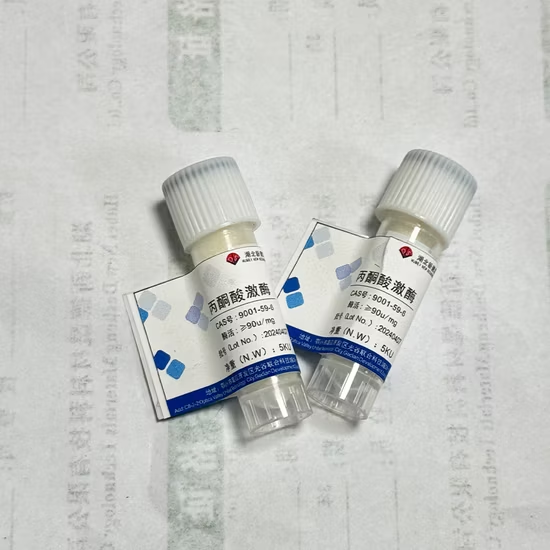
Pyruvate Kinase Enzyme Preparations Raw Materials for in Vitro Diagnostic Reagents
Overview Pyruvate kinase; Kinase (phosphorylating), pyruvate; PK, also known as pyruvate phosphotransferase, pyruvate-2-
- Overview
- Product Description
- Product Parameters
- Application
- Product Performance
- Precautions
- Company Profile
Basic Info.
| EINECS | No |
| Classification | Biological Agents |
| Grade | AR |
| Specific Usage | For Biological Purpose |
| Content | Standard |
| Usage | Laboratory Reagents, Analytical Reagents, Diagnostic Reagents |
| Source | Composition |
| Habit Appellation | S-Adenosylmethionine Synthetase Sams |
| Application | Scientific Research, Health |
| Property | Biochemical Reagent |
| Storage | Low Temperature Storage |
| Use to | in Vitro Diagnostic Kit |
| Manufactor | Hubei New Desheng Material Technology Co., Ltd |
| Dosage Form | White Freeze-Dried Powder |
| Transport Package | Refrigerated Transport |
| Specification | 10ku/bottle |
| Trademark | DeSheng |
| Origin | Ezhou City, Hubei Province, China |
| Production Capacity | 50g Per Month |
Product Description
Pyruvate kinase; Kinase (phosphorylating), pyruvate; PK, also known as pyruvate phosphotransferase, pyruvate-2-O-phosphotransferase, or phosphopyruvate kinase, catalyzes the production of pyruvate and ATP from phosphoenolpyruvate (PEP) and ADP. Acetoacetate kinase plays a crucial role in regulating metabolic flux and ATP production. Pyruvate kinase converts phosphoenolpyruvate and ADP into ATP and pyruvate, and is one of the main rate limiting enzymes in glycolysis. It has two isoenzymes, M-type and L-type. M-type has M1 and M2 subtypes. M1 is distributed in the myocardium, skeletal muscle, and brain tissue; M2 is distributed in tissues such as the brain and liver. L-type isoenzymes mainly exist in the liver, kidneys, and red blood cells. After myocardial cell necrosis, PK is released into the bloodstream, and PK measurement can be used to diagnose myocardial infarction.1.Enzyme activity assay kit: Acetoacetate kinase activity assay kit: specifically designed to determine the activity of PK in samples, suitable for blood, tissue, cells, and other samples. Glycolytic enzyme activity assay kit: including key enzymes in various glycolytic pathways, PK is one of them, used to comprehensively evaluate the activity of glycolytic pathways. 2.Metabolic analysis kit: Glycolysis Pathway Analysis Kit: Used to study the glycolysis pathway in cells or tissues, PK, as one of the key enzymes, helps evaluate the efficiency of the entire pathway. Energy metabolism analysis kit: used to determine the energy metabolism status in cells or tissues, and PK activity is one of the important indicators. 3.Enzyme activity assay kit: Acetoacetate kinase activity assay kit: specifically designed to determine the activity of PK in samples, suitable for blood, tissue, cells, and other samples. Glycolytic enzyme activity assay kit: including key enzymes in various glycolytic pathways, PK is one of them, used to comprehensively evaluate the activity of glycolytic pathways. 4.Metabolic analysis kit: Glycolysis Pathway Analysis Kit: Used to study the glycolysis pathway in cells or tissues, PK, as one of the key enzymes, helps evaluate the efficiency of the entire pathway. Energy metabolism analysis kit: used to determine the energy metabolism status in cells or tissues, and PK activity is one of the important indicators.
1.Efficient catalytic ability: Acetoacetate kinase can efficiently catalyze the conversion of phosphoenolpyruvate (PEP) to pyruvate, while converting ADP to ATP. This reaction is a crucial step in the glycolysis pathway, ensuring the rapid generation of cellular energy. 2.High specificity: PK has high specificity for substrates PEP and ADP, which means it can accurately identify and catalyze specific reactions in complex biological systems, reducing the occurrence of non-specific reactions. 3.Wide substrate affinity: PK has a high affinity for substrates and can effectively catalyze reactions even at low concentrations, which is particularly important for detecting trace samples. 4.Long term storage: Acetoacetate kinase can maintain its activity for a long time under appropriate storage conditions (such as freezing or refrigeration), making it easy for long-term use and transportation in the laboratory.
This reagent is only used for research and development or production, and is strictly prohibited from being used in human or animal experiments
Hubei New Desheng Material Technology Co., Ltd. specializes in the production of blood collection tube additives, chemiluminescent reagents, biological buffers, chromogenic substrates, enzyme preparations, antigen antibodies and other biochemical reagents. Founded in 2005, Desheng has a professional R&D team and advanced production equipment!
Product Description
Product Parameters
| Dosage form: | White freeze-dried powder, or liquid | Molecular weight: | 63kDa(SDS-PAGE detection) |
| Save buffer: | Tris Cl buffer, pH 7.50 | Purity | ≥ 90% (SDS-PAGE detection) |
| Enzyme activity: | 400 U/mg | Transportation Conditions: | Low temperature, ice bag |
| Source: | Gene recombination expression | Safety tips: | Not applicable for human experiments |
| Vitality unit: | The amount of enzyme required to convert 1.0 μ mol of phosphoenolpyruvate to pyruvate per minute at pH 7.2 and 30 ºC. | ||
| Storage condition: | Suggest packaging and storage to avoid repeated freezing and thawing affecting protein activity | ||
Application
Product Performance
Precautions
Company Profile
Send to us